RFTagIT input tag:
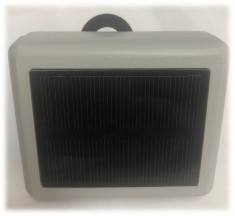
The input controller can convert 2 input signals to LPWan connection.
The device is Either battery powered with Solar re- charge capabilities or externally powered via a small dc power source.
The inputs are internally pulled up so only a contact clo- sure or transitive short is required to trigger the input pulse. Pulses are internally debounced to avoid false triggers with a max input rate or 200Khz.
The Sensor is very efficient employing LoRaWAN™ long-range transceiver or LPwan Thingstream communications. These allow bidirectional communications to the sen- sor module. The sensor is battery powered employing long-range transceiver with low power consumption. Intelligent Real-time usage data is gathered wirelessly and pro- cessed automatically. Data is accessible from your LoRaWAN™ provider or via the ThingSteam network or on the RFtagIT app. Pulse metering Frequent reporting pro- vides a detailed usage overview.
• Can be used with any pulse emitting device (water, electricity, gas meter, etc.).
• Battery condition and dc power monitor is also possible.
• Analog measurement Possible.
• Configurable trigger condition allows event detection with arm thresholds.
• This allows the unit to be deployed outdoor Pulse Reader can be configured to trigger mode to send alerts when usage is detected.
Features:
Lifetime depends from the device location and reporting interval.
Trigger mode.
Configurable reporting interval.
Maintenance free - install & forget.
Easy installation.
Average life 5 years.*
Secure communication.
Thresholds.
Thingstream LPWan compared with LoRaWAN Thingstream:
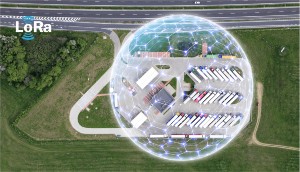
• Uses GSM, available across + 190 countries.
• Single IoT SIM for global coverage.
• OPEX, no major CAPEX outlay.
• Uses standard off the shelf modems (2G, 3G, LTE).
• Low cost, $1 a month for 10,000 IoT messages.
• No cross-border roaming costs.
• Coverage in remote locations.


LoRa:
• Limited global deployments.
• Not a stand-alone end-to-end connectivity solution.
• CAPEX investment requirement (Local Gateway de- ployment).
• Shared spectrum with other LoRa networks.
• Low cost.
• Localised coverage across municipalities and do- mestic areas.
• Limited to fixed locations.
SPECIFICATIONS:
Lora Sensor:
• Length: 89 mm
• Height: 32 mm
• Width: 76 mm
• Weight: 72 g Cable length: 1 m
• Operating temperature: -20°C ... +65°C
• Communication range: up to 15 km*
• Tx power: up to +20 dBm
• Rx Sensitivity: -142 dBm
• MAC Layer: LoRaWAN™
• Physical Layer: LoRa®
• Connector:M8
• Body material: ABS IP Rating: IP65
• Communication: LoRaWAN™
*Communication range is dependent on the location of the sensor and nearest base station.
ThingStream Sensor:
• Length: 89 mm
• Height: 32 mm
• Width: 76 mm
• Weight: 72 g
• Cable length: 1 m
• Operating temperature: -20°C ... +65°C
• Communication range: up to 15 km*
• Tx power: up to +20 dBm
• Rx Sensitivity: -142 dBm
• MAC Layer: ThingStream™
• Physical Layer: ThingStream®
• Connector: M3.5 mm Phoenix type
• Body material: ABS UV stabilised
• IP Rating: IP65
• Communication: Thingstream™
*Communication range is dependent on the location of the sensor and nearest base station.
INPUT SPECIFICATIONS:
• Digital Max Frequency: 15 Hz (Dry contact) Pulled internally to: 3 V
• Transitive Short (open Drain) Pulled internally to: 3 V
POWER SUPPLY:
• Certified battery: LiPo 18650 3.6V 1.1A/hr
• Service life dependent on input signal frequency: > 3 years at 1Hz
• DC Power Source 5V to 12V regulated 300 mA.
COMMUNICATION:
• Physical Layer: LoRA™-915MHz or 868MHz dependant on local requirements
• MAC Layer: IEEE 802.15.4-2006 (non beacon enabled CSMA/CA)• Network: IPv6 / 6LoWPAN
• Routing: Node RED• Transport/presentation: UDP
Water Flow Monitoring
Description:
With the recent increase in extreme weather events, water is becoming a sort after commodity and its usage is becoming a front page news topic. A great amount of water is being lost through leaks in the piping infrastructure. Water leakage and meter reading represent two of the biggest operational costs for water utilities.
By implementing a smart water infrastructure, comprised of sensors, gateways, automated meter read-
How a LoRaWAN-based Water Tank Monitor monitoring system works.
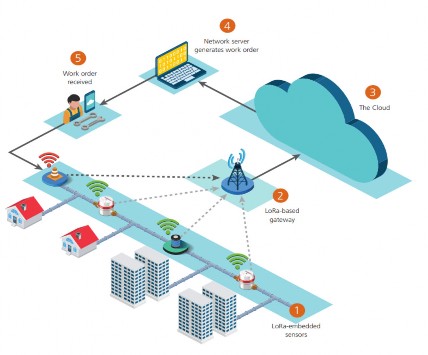
Semtech LoRa Technology enables connectivity, real-time analytics, reporting, and additional functions such as geolocation.
Multiple sensors embedded with Lo- Ra Technology are placed on water pipes leading into homes or buildings.
If sensors detect a leak, they send an alert to a LoRa-based gateway; meter readers can also send information to the gateway about irregular readings that may indicate a leak.
Gateway sends information to the LoRa® Network server, where the da- ta is analysed by an application server
Application server generates a work order.
Maintenance personnel receive work order via computer or mobile device, so that leak repairs can be scheduled and taken care of quickly.
BENEFITS:
Reduce utility operational expenses with precise detection of broken Water Tank Monitors through sensors and automated meter readers embedded with LoRa Technology
Dramatically reduce service costs as low-power operation ensures sensor batteries can last up to 20 years.
Reliable RF communication link between sensing infrastructure and LoRaWAN-based network provides excellent underground coverage
APPLICATIONS Utilities have a wide range of sensing solutions to monitor Water Tank Monitors, including: SMART METERING